Protection classes
Body Armor Plates: Which Class, How Much They Weigh, What Size
· 7 min read
You need a hard plate when the threat is an assault rifle or a rifle: soft armor does not stop those bullets. Choose the class by the cartridge: Br4 for assault rifles, Br5 for rifles and armor-piercing rounds. Choose the size by your chest and the vest pocket. Our ceramic Br5 plate weighs 2.75 kg, a pair 5.5 kg.
Which plate you need: the short answer
| Threat | What you need |
|---|---|
| Handgun, knife, fragments | soft armor panel Br1 or Br2, a plate is optional |
| AK-74 or AKM assault rifle | Br4 plate |
| SVD rifle, 7.62×54R machine gun, armor-piercing bullets | Br5 plate |
| 12.7 mm heavy rifle | Br6: we do not fit such plates, our pockets are rated up to Br5 |
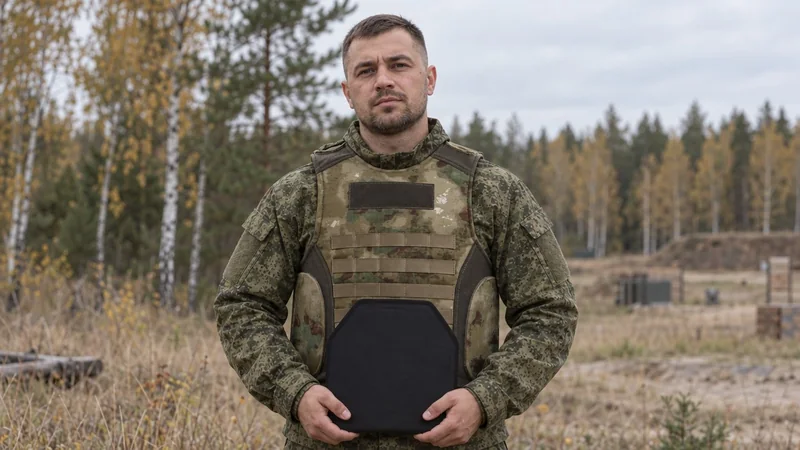
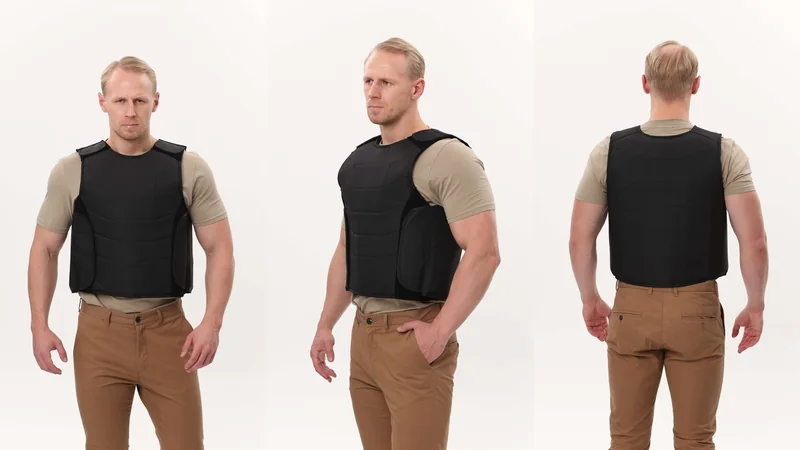
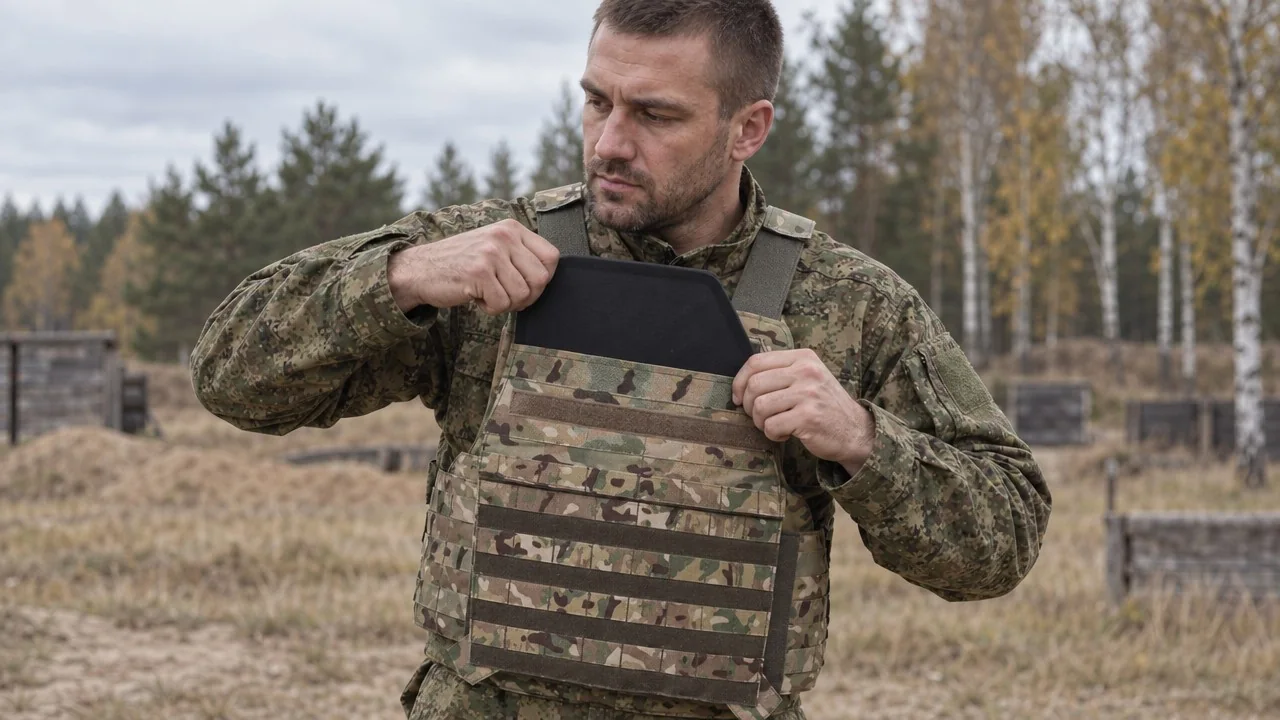
A plate covers the heart, lungs and major blood vessels, front and back. The sides, shoulders and abdomen are protected by the soft panel. That is why the plate goes into the vest on top of the soft panel, not instead of it.
What Br4, Br5 and Br6 plates stop under GOST
A class in GOST 34286-2017, the Russian body armor standard, describes a test: which weapon, which bullet, at what velocity and from what distance. Br4 and Br5 plates are shot from 10 metres, Br6 from 50. No penetration and the blunt impact behind the plate within the limit - the plate gets the class.
| Class | Weapon | Cartridge and bullet | Bullet mass | Velocity | Energy, approx. |
|---|---|---|---|---|---|
| Br4 | AK-74 assault rifle | 5.45×39, 7N10 | 3.5 g | 895±15 m/s | 1,400 J |
| Br4 | AKM assault rifle | 7.62×39, PS | 7.9 g | 720±15 m/s | 2,050 J |
| Br5 | SVD rifle | 7.62×54R, 7N13 | 9.4 g | 830±15 m/s | 3,240 J |
| Br5 | SVD rifle | 7.62×54R, B-32 armor-piercing incendiary | 10.4 g | 810±15 m/s | 3,410 J |
| Br6 | OSV-96 rifle | 12.7×10⁸, B-32 | 48.2 g | 830±20 m/s | 16,600 J |
We calculated the energy from bullet mass and velocity: the standard does not list it. All these bullets have a hardened steel core. The plate must keep its rating from minus 40 to plus 40 °C and after immersion in water.
A plate stops what it was tested against. Br5 in the documents means the plate was shot with 7N13 and B-32 bullets and stopped them. About other cartridges the document says nothing.
Br4 or Br5: which to choose
A Br5 bullet carries 1.5-2 times more energy than Br4 bullets, so the plate needs a thicker or harder strike face. That is why a Br5 plate is usually heavier and thicker than a Br4 plate of the same material.
Br4 is rated for 5.45×39 and 7.62×39 assault rifle rounds. It suits cases where the threat is known and weight matters more than margin, for example when the vest is worn for many hours. Br5 is needed if a 7.62×54R rifle bullet or an armor-piercing round is possible. When the threat is unknown, choose the class by the strongest possible one.
How much an armor plate weighs
Weight depends on class, material and size; GOST sets no weight limit.
- Ceramic with a UHMWPE backing. This is how our Br5 plates for OBSIDIAN MAX are built: 10 mm of alumina ceramic and 12 mm of ultra-high-molecular-weight polyethylene. Size 250×295 mm, thickness 23 mm, one plate weighs 2.75 kg, a pair 5.5 kg. The plates are certified to GOST 34286-2017, class Br5.
- Other ceramics. Silicon carbide and boron carbide are lighter than alumina. Plates made of them are lighter at the same class, but cost more.
- Steel. Heavier than ceramic at the same size, but it does not crack on impact. A bullet breaks up into fragments on steel, so steel plates get an anti-spall coating.
- UHMWPE only. The lightest plates. Against bullets with a hardened steel core, pure polyethylene performs worse than ceramic, so Br5 plates are more often hybrid. More in Ceramic or UHMWPE.
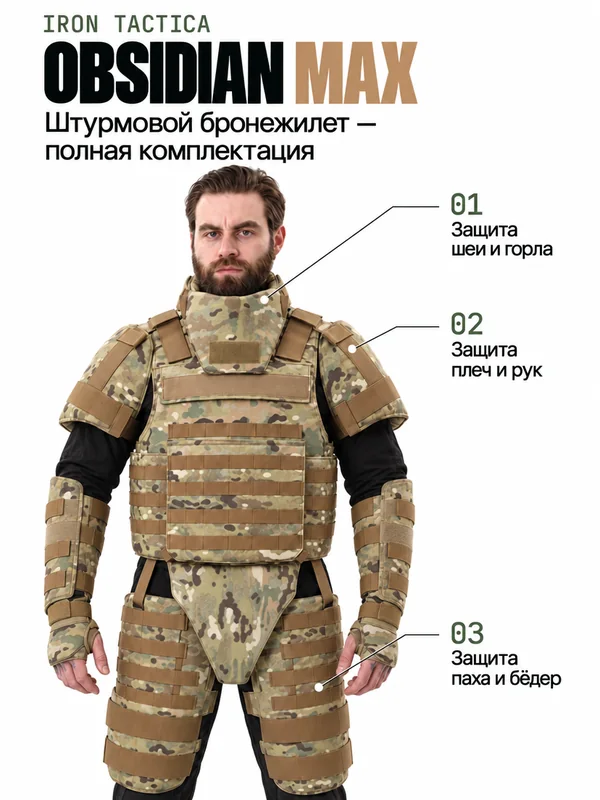
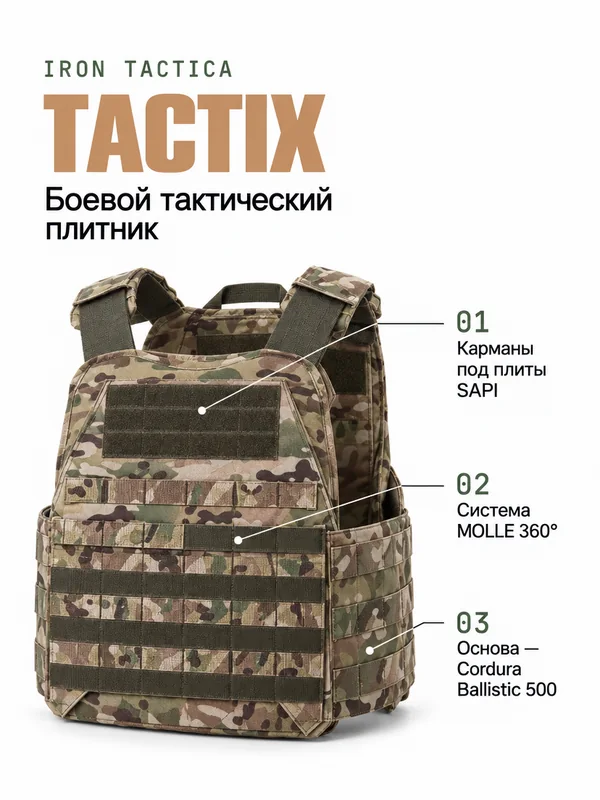
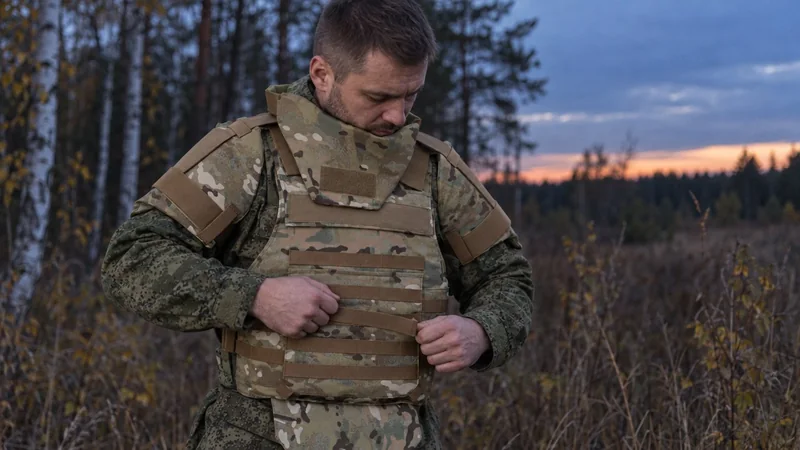
Add the weight of the vest. TactiX weighs 1.5 kg, about 7 kg with two Br5 plates. The full OBSIDIAN MAX kit, with plates and neck, shoulder, arm and leg modules, weighs 15 kg: what makes up that weight is covered in our article on assault body armor.
Armor plate sizes
A plate should cover the heart, lungs and major blood vessels without getting in the way when you bend or use your arms. Match its width to the distance between your nipples; the top edge sits at the notch at the base of the throat.
| Size | Width × height |
|---|---|
| 25×30 cm | 250×300 mm |
| Our Br5 plate in OBSIDIAN MAX | 250×295 mm, 23 mm thick |
| 10×12 inches | 254×305 mm |
| SAPI Small | 222×298 mm |
| SAPI Medium | 241×318 mm |
| SAPI Large | 260×337 mm |
| SAPI XL | 279×356 mm |
Russian makers label sizes "1", "2" and "3", each in their own way; there is no common chart. Check millimetres and thickness: a thick plate may not fit the pocket even if width and height match. A 25×30 plate and SAPI Medium are different too: SAPI is narrower and taller.
How to match a plate to your vest
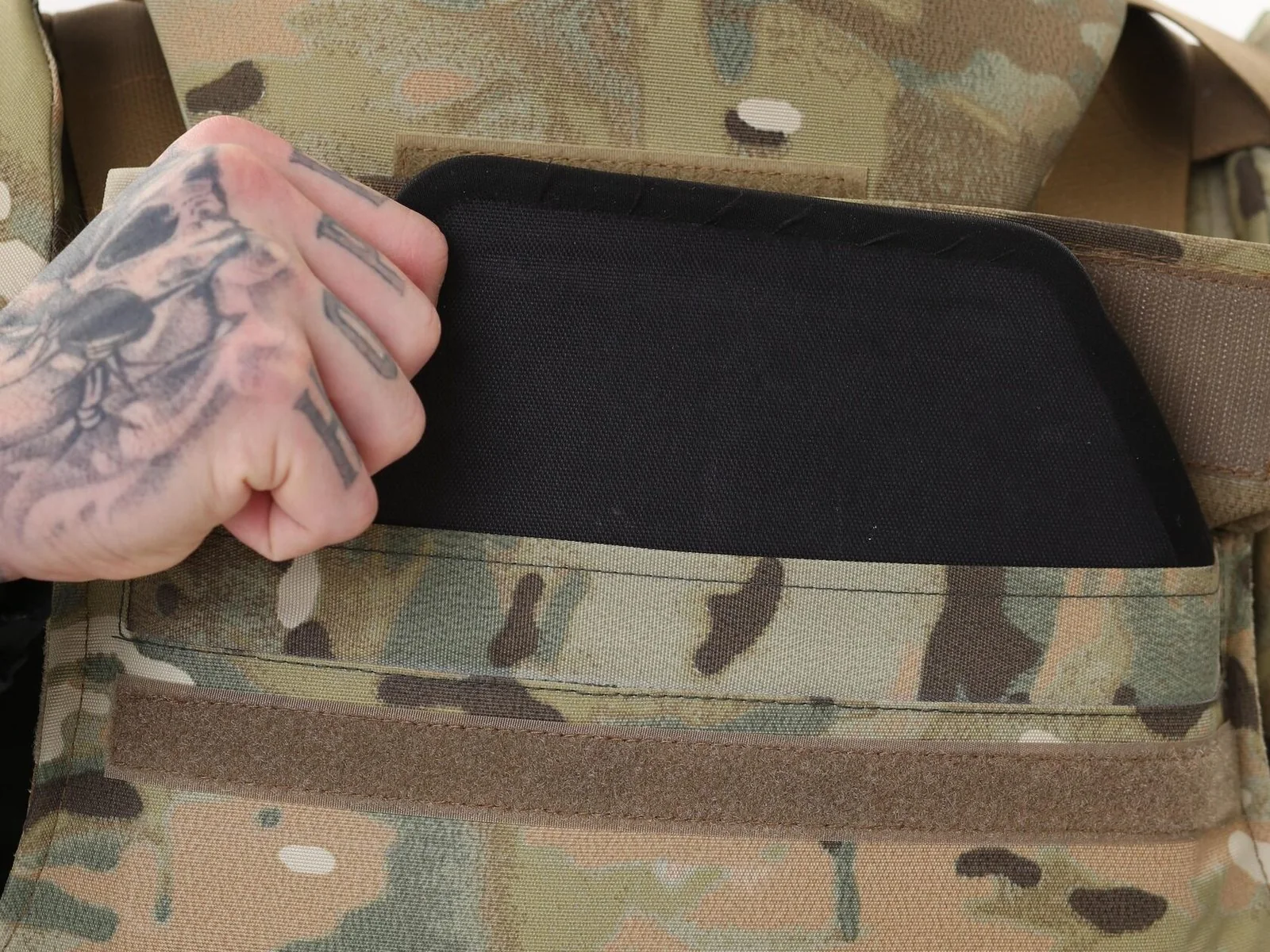
The plate pockets in our models are universal: they take plates of common sizes. The plate goes on top of the vest's soft ballistic panel. The panel covers the area around the plate and catches fragments if the bullet breaks the plate's strike face. How a plate carrier differs from a vest with plate pockets is covered in Plate Carrier or Body Armor Vest.
- TactiX - a 1.5 kg plate carrier with a built-in Br1 panel and UHMWPE side panels. Plates are sold separately.
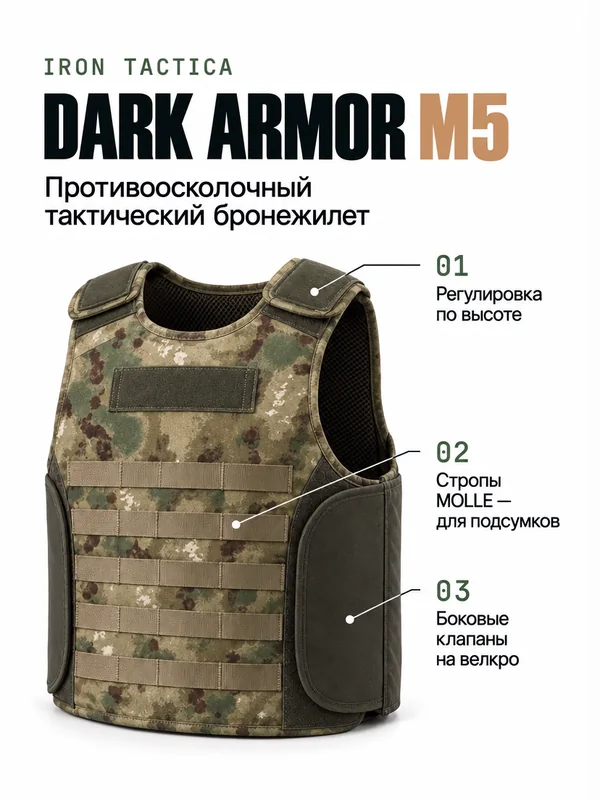
- DARK ARMOR M-5 - a vest with Br2 panels all around, including the sides, and plate pockets.
- OBSIDIAN MAX - an assault kit with two certified Br5 plates included.
We make every model on the "Tactical and assault" page to measure at no extra cost. Call 8 800 101-76-37 and tell us what you need protection from and how many hours a day you will wear the vest: we will choose the model and plates.
How to check the documents for an armor plate
- A certificate of conformity to GOST 34286-2017 with class Br4 or Br5, valid on the date of purchase.
- A test report: which bullet was used and which laboratory ran the test. A class without a test report is just a label.
- Markings on the plate: class, size, production date and which side faces out.
- Condition: no cracks, dents or swelling. A plate that took a hit or a hard blow is replaced: an internal crack is not visible from outside.
How to read a certificate and a test report is covered in our article on choosing a body armor manufacturer.
FAQ
Will a Br5 plate stop a 7N21 bullet? 7N21 is the Br3 test bullet, a handgun round with about 590 J of energy, several times less than Br5 bullets. But GOST does not test Br5 plates with it, so only the test report of a specific plate answers this.
What does a Br2 armor plate stop? Br2 is a handgun class: a 9×21 bullet from an SR-1 pistol at 5 metres. Against an assault rifle you need Br4 or higher. In our vests, Br2 comes from the soft panels; see Br1 or Br2 for details.
Is Br5 the same as NIJ Level IV? No. Level IV under the US standard is tested with a .30-06 M2 AP armor-piercing bullet, Br5 with Russian 7N13 and B-32 bullets. The bullets and test procedures differ, so there is no direct conversion.
What do "5a" or "class 6" on a plate mean? These are classes from GOST R 50744-95, which was withdrawn in 2019. They do not convert directly into Br classes: check the documents to see which bullet the plate was tested with.
Which side of the plate faces out? The side marked "strike face" or "this side toward threat" faces out, away from the body. On a curved plate, the convex side faces out. A plate inserted backwards protects worse than rated.